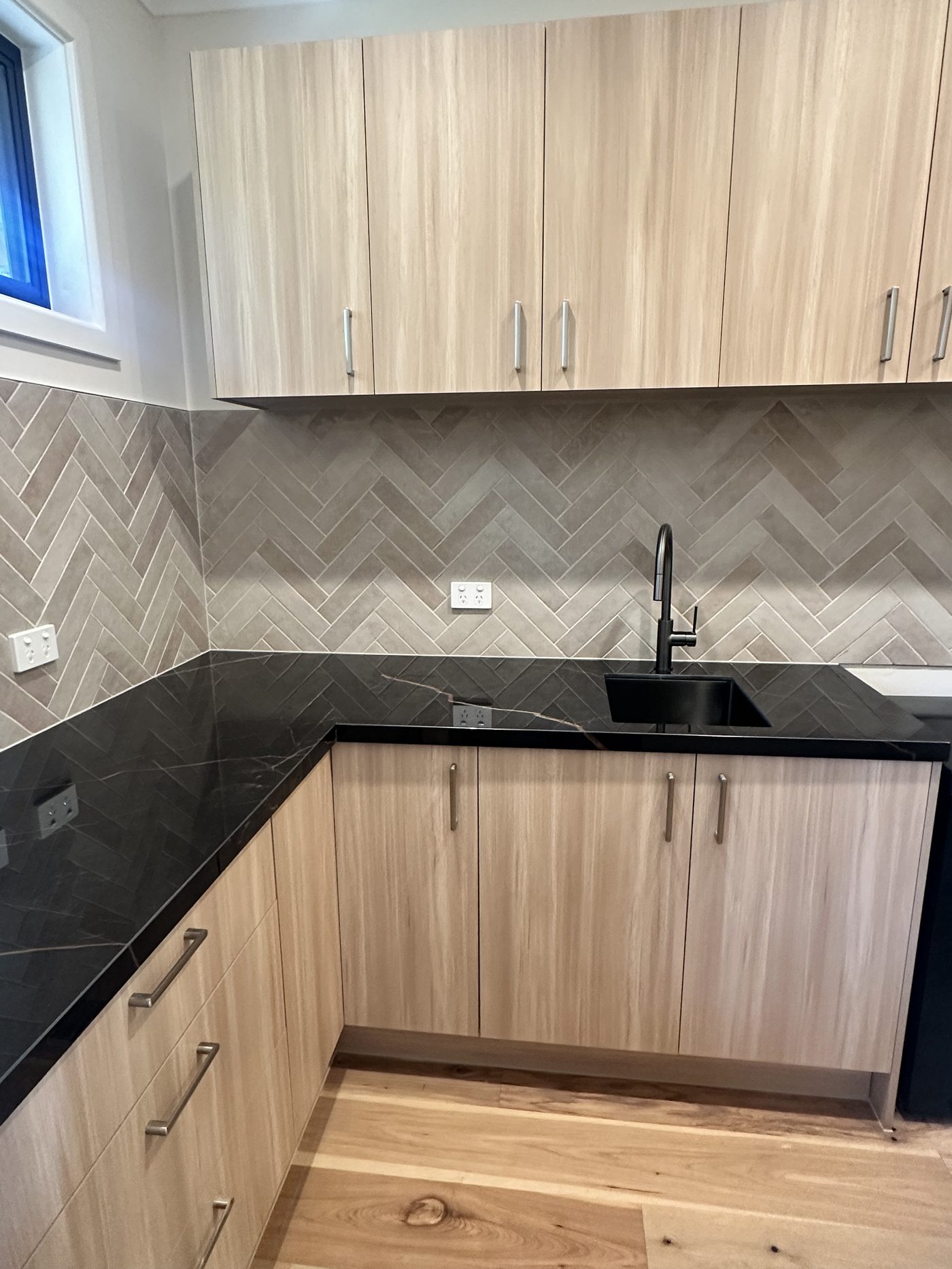
Engineered stone
Engineered stone (sometimes called quartz or reconstituted stone) has been the dominant premium benchtop material in Australian kitchens for the past decade. It consists of crushed quartz or other stone aggregates bound with polymer resin, then formed into slabs.
From 1 July 2024, engineered stone products containing more than 1% crystalline silica are banned in Australia due to the silicosis risk to fabricators. This has significantly changed the engineered stone market. Low-silica and silica-free products (using materials like recycled glass, granite, or porcelain aggregates) are now the compliant options. Confirm with any supplier that their product meets current Australian requirements.
Engineered stone cost
$3,500–$8,500 installed for a medium kitchen benchtop, depending on thickness (20mm vs 40mm), edge profile, and product range. Silica-free alternatives may carry a small premium over their silica-containing predecessors.
Engineered stone pros and cons
- Non-porous — stain resistant compared to natural stone
- Consistent appearance — no natural variation to manage
- Wide range of colours and patterns
- Not heat resistant — hot pans can damage the resin
- Can chip at edges if knocked hard
Natural stone
Marble, granite, and quartzite are the natural stone options used in Australian kitchens. Each is quarried, cut into slabs, and fabricated to measure.
Marble is beautiful, porous, and high-maintenance — it stains, etches with acids, and scratches. It is best suited to owners who appreciate the patina that develops with use and are willing to seal and maintain it. Granite is harder and less porous than marble. Quartzite (often confused with engineered quartz) is a natural metamorphic stone — harder than marble, with similar veining aesthetics.
Natural stone cost
$5,000–$15,000+ installed, depending on the specific stone, slab quality, and fabrication complexity.
Porcelain slab
Porcelain slabs (large-format sintered stone, including products like Dekton and Neolith) are the fastest-growing premium benchtop category. They are extremely hard, heat-resistant, UV-stable, and available in very large format slabs with minimal joins.
The trade-off is that porcelain is brittle — it cannot be chipped and repaired the way stone can, and on-site cutting requires skilled fabricators. It is also more expensive to fabricate due to this complexity.
Porcelain cost
$5,500–$12,000+ installed for a medium kitchen.
Featured stone supplier: Lavistone
Lavistone
Premium engineered stone, porcelain slab and natural stone for Australian kitchens and bathrooms.
Lavistone supplies premium bench and surface stone products to kitchen designers, cabinet makers, and homeowners across Australia. Their range covers engineered quartz surfaces, large-format porcelain slabs, and natural stone options — all sourced to meet Australia's current silica compliance requirements.
Low-silica engineered quartz in over 40 colours. 20mm and 40mm available. Scratch, stain and heat resistant. 15-year residential warranty.
Ultra-compact sintered surface. UV stable, heat proof, and scratch resistant. Suitable for outdoor kitchens. Available in 12mm and 20mm thickness.
Curated natural marble, granite, and travertine slabs. Each slab is unique. Supplied direct to fabricators and kitchen companies across Australia.